


“Deploy an AI Agent for Shopify to automate 50% of support (WISMO, FAQs), proactively upsell, and guide product discovery—boosting sales and saving your team valuable hours.”
Running a Shopify store is a daily hustle. You are the CEO, the marketing director, the inventory manager, and, all too often, the entire customer support team. Every entrepreneur hits a ceiling. It’s the point where you spend so much time reacting to problems—like answering emails and tracking orders—that you have no time left to be proactive and actually grow your business.
The single biggest time-drain? Repetitive customer support. “Where is my order?” “What’s your return policy?” “Do you ship to Canada?”
These questions, while simple, are a bottleneck. They stop you from focusing on marketing, product development, and strategy. For years, the only solution was to hire a support team, which is expensive, or just accept that you’ll be stuck in your inbox for hours every day.
But what if you could change that? What if you had an assistant?
Imagine a team member who works 24/7, never sleeps, and costs next to nothing. An assistant who has memorized every product spec, knows your shipping policy by heart, and can instantly access every customer’s order status. Now, what if that same assistant was also a master salesperson, trained to guide new customers to the perfect product, upsell them at checkout, and recover abandoned carts?
This isn’t science fiction. This is what a modern AI agent for Shopify does.
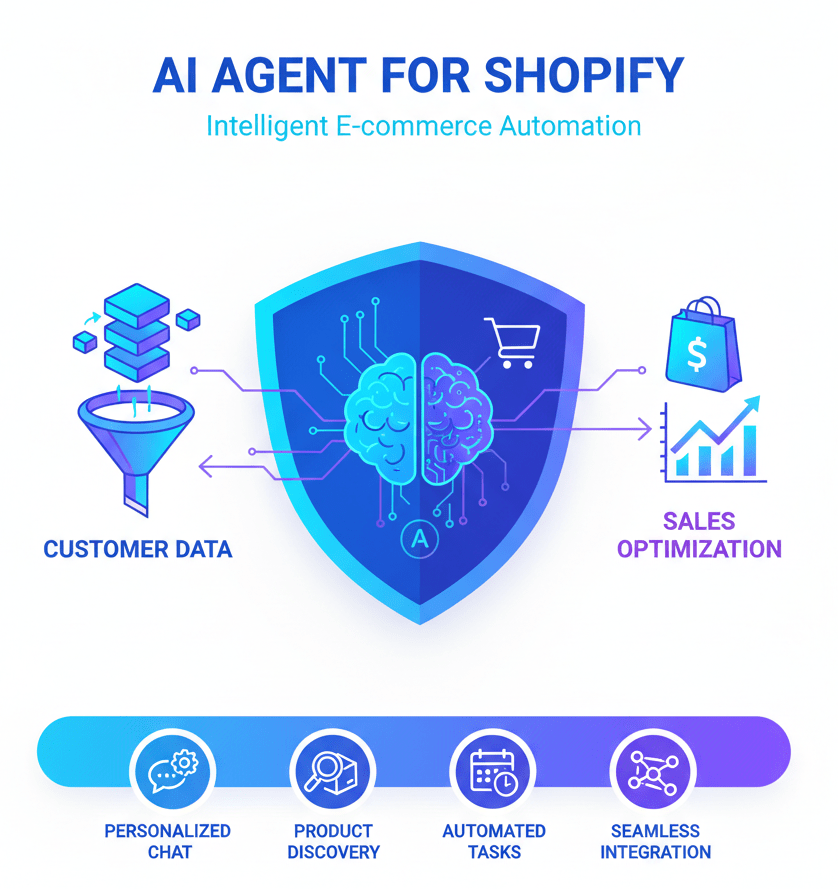
This is not just another dumb “Shopify chatbot app” that can only answer “yes” or “no” to a few pre-programmed questions. We’re talking about a true e-commerce automation powerhouse. It’s a single tool designed to tackle your two most significant challenges: it slashes your support ticket volume while actively working to increase your conversion rate.
If you’re ready to break through that ceiling, this guide will show you how to do so. We’re going to outline 10 specific, actionable ways this technology transforms your store from a manual time drain into an automated, revenue-driving machine.
1. Slay the “WISMO” Dragon with 24/7 Order Tracking
The Problem: The “Where Is My Order?” (WISMO) question. It is, without a doubt, the most common, repetitive, and time-consuming ticket for any e-commerce store. It floods your inbox, clogs your DMs, and takes you away from valuable work. Each WISMO query requires you to stop what you’re doing, open Shopify, find the customer’s order, check the fulfillment status, copy the tracking link, and then paste it into an email. It’s a 5-minute task that you have to repeat 10, 20, or 50 times a day.
The AI Agent Solution: An actual AI agent integrates directly with your Shopify database. It’s not just a chat window; it’s an order tracking bot with full access to your order management system.
When a customer asks, “Where’s my stuff?” the AI agent can instantly:
- Ask for their order number and email to verify their identity.
- (If the customer is logged in) Automatically identify them and pull up their recent orders.
- Access the order’s real-time status: “Processing,” “Shipped,” or “Out for Delivery.”
- Provide the customer with the tracking number and a direct link to the carrier’s tracking page.
Why It Works:
- Support Reduction: This single feature can eliminate 30-50% of your entire support volume. Overnight. Think about what you could do with all those hours back in your day. It’s the single biggest win for customer support for Shopify.
- Boosts Sales (Indirectly): This builds massive trust. Customers don’t want to wait 24 hours for a simple tracking link. An instant, professional, 24/7 answer makes your brand feel reliable and high-tech, just like the retail giants. That confidence is what creates repeat customers. A bad post-purchase experience is the fastest way to lose a customer for life.
Example in Action:
- Customer (at 2 AM): “I need to check my order status.”
- AI Agent: “I can help with that! Please enter your 5-digit order number found in your confirmation email.”
- Customer: “12345”
- AI Agent: “Got it! Your order #12345, the ‘Pro Series Coffee Grinder’, shipped on October 29th via UPS. It’s currently ‘Out for Delivery’ and scheduled to arrive today. You can track its progress live here: [ups.com/tracking/1z…]”
That entire interaction lasted only 10 seconds, with no human involvement.
2. Turn Returns & Exchanges into a Self-Service Flow
The Problem: Returns are a logistical nightmare. They are high-friction, costly, and involve a frustrating back-and-forth email chain. A customer must email you, wait for a reply, explain their issue, confirm they are within the policy window, obtain approval, and then wait again for you to manually generate a shipping label. This slow process annoys the customer and costs you valuable time.
The AI Agent Solution: Your AI agent can be trained on your exact return policy. It knows which items are final sale, what your 30-day window is, and what the process is. It can act as an automated, conversational returns portal.
The flow looks like this:
- A customer says, “I need to return my item.”
- The AI agent pulls up their order history and asks, “Which item from your order #12345 would you like to return?”
- The agent confirms the item is eligible based on your policy.
- It then asks the reason for the return (e.g., “Wrong Size,” “Not as Described,” “Changed Mind”). This is priceless data for you.
- Crucially, the agent can then be programmed to save the sale. “I see you selected ‘Wrong Size’ for the Medium T-Shirt. We have the Large in stock! Would you prefer a free exchange instead of a refund?”
- If they still wish to return the item, the agent can automatically initiate the return in Shopify and provide the customer with the return shipping label, all within the chat.
Why It Works:
- Support Reduction: This turns a multi-day, 5-email process into a 60-second self-service interaction. It completely removes your team from the mundane parts of the returns process.
- Boosts Sales: This is a massive conversion driver. Studies show that a significant percentage of shoppers check a store’s return policy before making a purchase. A complex, manual, email-based policy creates friction and uncertainty. A simple, automated, instant process gives customers the confidence to click “Buy Now.” By proactively offering exchanges over refunds, the AI also directly protects your revenue.
3. Become a 24/7 Personal Shopper with a Conversational Product Finder
The Problem: A customer lands on your store. You have 300 products. They are overwhelmed by choice and don’t know where to start. They don’t know which skincare product is for oily skin, which laptop bag fits a 15″ screen, or which coffee bean has “chocolaty notes.” They get confused, frustrated, and leave.
The AI Agent Solution: This is where the product recommendation AI capabilities truly shine. The agent transforms from a support bot into an expert sales associate. It’s trained on all your product descriptions, tags, and categories. It doesn’t just link to a collection; it asks qualifying questions to understand the customer’s intent and needs.
Example in Action:
- AI Agent: “Hi! Welcome to Outdoor Essentials. Are you looking for gear for hiking, camping, or climbing today?”
- Customer: “I need a new hiking boot.”
- AI Agent: “Great! Are you planning light day hikes or a more rugged, multi-day backpacking trip?”
- Customer: “Multi-day trip, definitely.”
- AI Agent: “Got it. In that case, you’ll need maximum support and durability. Our top recommendations are the ‘TrekMaster Pro’ and the ‘Summit GTX’. The ‘TrekMaster’ is lighter, while the ‘Summit’ offers full waterproofing. What’s more important to you?”
- Customer: “Waterproofing.”
- AI Agent: “Perfect choice. Here is the ‘Summit GTX’. We have it in 3 colors. You can see it here: [Product Link]”
Why It Works:
- Boosts Sales: This is guided selling, 1-on-1, at scale. It cuts through the “paradox of choice” and mimics the perfect in-store sales experience. It navigates the customer directly to the product that solves their specific problem, which dramatically increases the conversion rate.
- Support Reduction: This prevents all those pre-sale questions from ever becoming support tickets. It also reduces returns, because the customer is guided to buy the right product the first time.
4. Provide Instant, Accurate Answers to All Policy FAQs
The Problem: “What are your shipping times?” “Do you ship to Germany?” “What’s your warranty?” “Are your products cruelty-free?” These are simple questions, but they are endless. If a customer can’t find the answer in 10 seconds, they won’t bother to look for your FAQ page. They’ll just close the tab and buy from your competitor.
The AI Agent Solution: An AI agent isn’t limited to “canned responses.” You can train it on your entire knowledge base. You simply feed it the text from your Shipping Policy page, your FAQ page, your ‘About Us’ story, and any other policies. The AI ingests this information and understands it.
When a customer asks a question, the agent doesn’t just link to the policy page (a lazy, unhelpful action). It reads the relevant information and gives a direct, natural language answer.
Example in Action:
- Customer: “How long does shipping to Texas take?”
- AI Agent (having read your shipping page): “Great question! We ship from our warehouse in Ohio. For orders to Texas, our Standard Shipping (via USPS) typically takes 3-5 business days. We also offer a 2-Day Express option.”
Why It Works:
- Support Reduction: This is another significant category of repetitive tickets that often disappear. Your inbox becomes cleaner, instantly.
- Boosts Sales: This is all about removing friction. Every unanswered question is a point of doubt. Every second a customer has to spend hunting for information is a chance for them to abandon their cart. Instant, accurate, and confident answers build trust and keep the customer on the smooth path to checkout.
5. Proactively Upsell and Cross-Sell Like a Master Salesperson
The Problem: You’re leaving money on the table. A customer adds a camera to their cart. You know they need a memory card and a camera bag. Or they add a bottle of shampoo. You know they’d love the matching conditioner. Static “You Might Also Like” widgets are fine, but they’re passive and easy to ignore.
The AI Agent Solution: An AI agent is context-aware. It sees what a customer is browsing and what they add to their cart. This allows it to make intelligent, helpful suggestions at the perfect moment. This is a core function of a faithful 24/7 sales assistant.
Example in Action:
- Customer adds a “ProShot DSLR Camera” to their cart.
- AI Agent (proactively pops up): “Great choice on the ProShot! Just a heads-up, this model doesn’t come with a memory card. Most photographers pair it with our ‘High-Speed 128GB SD Card’ and the ‘Explorer Padded Bag’ to protect their new gear. Would you like to add those?”
Why It Works:
- Boosts Sales: This is the most direct way to increase your Average Order Value (AOV). The key is that it’s helpful, not pushy. It’s an expert suggestion that improves the customer’s experience with the main product. It can suggest batteries for a toy, a filter for a coffee machine, or a subscription plan for consumables. This is upsell and cross-sell automation at its best.
- Support Reduction (Indirect): By suggesting compatible accessories, the agent prevents post-purchase frustration and the resulting support tickets. (“I got my camera, but I can’t even use it, it needs a card!”)
6. Rescue Sales with Intelligent Exit-Intent Engagement
The Problem: A visitor has been browsing. They may even have added an item to their cart. But something makes them hesitate. They move their mouse cursor up to the back button or to close the tab. They are about to leave, likely for good.
The AI Agent Solution: The AI agent can detect this “exit intent” behavior. Before the customer clicks away, the agent proactively opens the chat window with a targeted, intelligent message. This is not a generic, annoying “WAIT! 10% OFF!” pop-up. It’s conversational and specific to their context.
Example Scenarios:
- If on a Product Page: “Hold on! Before you go, did you have a question about the ‘Luxe Suede Jacket’? I’m here to help with sizing, materials, or shipping info!” (This addresses hesitation).
- If on the Cart Page: “Leaving so soon? Just so you know, all orders over $75 get free shipping, and you’re only $10 away!” (This addresses a price objection).
- If on the Homepage: “Before you go, can I help you find something specific? You can also sign up for our newsletter to get 15% off your first order.” (This is a lead capture).
Why It Works:
- Boosts Sales: This is a direct, last-second intervention to save a lost sale and increase conversion rate. By offering help instead of just a discount, you can often resolve the underlying issue (e.g., “I was confused about shipping costs”) that led them to leave in the first place. It’s a safety net for your conversion funnel.
7. Automate Abandoned Cart Recovery Beyond Just Email
The Problem: A customer adds items to their cart and then leaves without completing the purchase. The standard Shopify flow is to send an automated email… hours later. By that time, that email is buried in their inbox, they’ve already bought from a competitor, or they’ve simply lost interest. Email open rates for abandoned carts are notoriously low.
The AI Agent Solution: The AI agent provides a powerful, real-time layer to your abandoned cart recovery strategy.
- On-Site (Pre-Abandonment): As mentioned with exit-intent, if a user is lingering on the checkout or cart page for too long (a sign of hesitation), the AI can proactively ask, “Looks like you’ve got some great items in your cart! Are you experiencing any issues with the checkout process? I can help.”
- On-Return (Post-Abandonment): This is the real game-changer. The customer leaves. They come back to your site two days later to browse. The AI agent remembers them and their cart. It proactively messages them: “Welcome back! I see you left the ‘Ultimate Skincare Kit’ in your cart last time. You’re just one step away! Would you like to complete your purchase now?”
Why It Works:
- Boosts Sales: This is far more effective than email. You are re-engaging the customer while they are already on your site and in a “shopping” mindset. It’s immediate, personal, and feels like high-touch customer service, not a robotic email blast. It closes the loop and guides them straight back to the checkout.
8. Gather Customer Feedback and Product Reviews on Autopilot
The Problem: You Need Social Proof. Product reviews are the lifeblood of e-commerce trust. You also need customer feedback to know what’s working and what’s not. However, requesting this information is a chore. You rely on third-party review apps that send emails a week later, and the engagement is often very low.
The AI Agent Solution: The AI agent is the perfect, neutral party to gather this data in the moment.
- Post-Support Interaction: After resolving an issue (like a WISMO request), the AI can ask, “Was I helpful in resolving your issue today? Please rate our conversation from 1-5.”
- Post-Purchase Feedback: When a customer returns to your site after their item has been delivered, the AI can trigger: “Welcome back! We see your ‘AeroPress’ was delivered last week. How are you enjoying it? We’d be thrilled if you could leave a review on the product page!”
- General Feedback: The agent can even ask open-ended questions, such as, “What’s one thing we could do to improve your shopping experience?” and log the answers for you.
Why It Works:
- Support Reduction (Indirectly): This feedback is a goldmine. You’ll quickly spot patterns. “Everyone is asking about the sizing on the blue jacket.” You can then update the product description, which proactively prevents future support tickets. You’re fixing the root cause of problems.
- Boosts Sales: More reviews = more social proof = more trust = higher conversion rate. It’s a simple, powerful equation. By automating the collection of these reviews in a conversational, on-site manner, you’ll achieve a significantly higher response rate than any email campaign.
9. Handle Complex, Technical Pre-Sale Questions with Expertise
The Problem: You sell a specialized product. Skincare (ingredient compatibility), electronics (specifications), supplements (dosages), or auto parts (fitment). A customer asks a high-intent question: “Will this 50mm f/1.8 lens work with my Canon R50 mirrorless body?” If you can’t answer that instantly and accurately, you lose a high-value sale. Your human support team might not even know the answer without spending 10 minutes on Google.
The AI Agent Solution: An actual AI agent can be trained on your entire library of technical data. You can upload user manuals, spec sheets, ingredient lists, and blog posts. The AI ingests this knowledge and becomes a product-level expert, available 24/7.
Example in Action:
- Customer: “Is your ‘Revitalize Serum’ safe to use at the same time as a product with retinol?”
- AI Agent (trained on your product data): “Great question! Our ‘Revitalize Serum’ is a Vitamin C-based formula. While you can use both ingredients in your routine, we strongly recommend using Vitamin C (our serum) in the morning and your retinol product at night. Using them at the same time can reduce the effectiveness of both and may irritate.”
Why It Works:
- Boosts Sales: This builds immense trust. You have just proven your brand’s expertise and saved the customer from a bad experience. This confidence is often the final push they need to buy a complex or high-ticket item.
- Support Reduction: It stops your most skilled (and expensive) support staff from being bogged down by particular pre-sale questions. It also prevents post-sale returns from customers who bought incompatible products.
10. Greet and Guide Visitors Based on Their Source (Personalization)
The Problem: A new visitor lands on your homepage. They are a blank slate. How do you guide them? Worse, what if they came from a particular Facebook ad you’re paying for—one about “Summer Dresses”? They shouldn’t be greeted with your winter coats. A one-size-fits-all homepage is a leaky bucket for your ad spend.
The AI Agent Solution: Your AI agent for Shopify can be innovative. It can detect where a visitor is coming from (UTM parameters from an ad) or if they are a new vs. returning customer. It then tailors its proactive greeting accordingly.
Example Scenarios:
- New Visitor (Organic): “Hi! Welcome to our store. To help you find the perfect item, are you shopping for yourself or looking for a gift?”
- Returning Customer: “Welcome back, [Customer Name]! We just got some new arrivals in our [Category They Previously Shopped] section. Would you like to see them?”
- Visitor from Facebook Ad (UTM=summer_dress_campaign): “Welcome! We see you’re interested in our new Summer Dress collection. I can show you our top 3 best-sellers right now!”
Why It Works:
- Boosts Sales: This is true personalization at scale. It’s the digital equivalent of a high-end boutique sales associate greeting you by name. By immediately acknowledging the visitor’s intent (based on their source) and displaying relevant products, you can dramatically reduce the bounce rate. You fast-track them to the items they are most interested in.
Likely to buy, giving you a much better ROI on your ad spend.
How to Get All This Done (Without Writing a Single Line of Code)
So, there you have it. Ten powerful, tangible strategies that an AI agent can execute for your Shopify store. It’s a 24/7 sales assistant that’s also your entire frontline customer support for Shopify. It finds sales, closes sales, and saves you countless hours per week.
At this point, you’re probably thinking, “This sounds amazing, but it must be costly, complex, and require a team of developers to build.”
A few years ago, you’d be right. You would have had to find a Shopify chatbot app from the Shopify app store, another app for returns, another app for upsells, and another app for page tracking. You’d be paying for five different subscriptions, and none of them would talk to each other.
That’s no longer the case. The technology has evolved.
We’d like to introduce Scalewise.ai.
Scalewise.ai is a free, no-code AI Agent Builder explicitly designed for Shopify merchants like you. It was created to do all 10 of the things we just described (and more) from a single, easy-to-use platform.
Here’s why it’s a game-changer:
- Truly No-Code: You don’t need to be a developer. If you can run a Shopify store, you can build a powerful AI agent in minutes.
- Train It Instantly: You don’t write rules. You just give Scalewise.ai your store’s website URL, connect your Shopify account, and upload your policy documents (like your shipping and return policies). It “learns” your entire store, all your products, and all your rules automatically.
- It’s Built for Shopify: This isn’t a generic chatbot. It’s an AI agent for Shopify built with deep integration. It can look up orders, process returns, and see customer carts right out of the box.
- It’s Free to Start: Scalewise.ai has a free plan. You can build your agent, put it on your store, and start reducing support tickets and boosting sales right now, without paying a cent.
You don’t need to hire a support team to grow your business. You don’t need to stay chained to your email inbox. You just need the right automation. This is the tool that lets you stop just running your store and finally start scaling it.
Frequently Asked Questions (FAQ)
Q1: Is an AI agent for Shopify tricky to set up?
Not at all. With a no-code platform like Scalewise.ai, you can have your agent live in under 10 minutes. You simply connect your Shopify store, provide your website URL, and it starts learning. You can then customize its name, personality, and color to perfectly match your brand.
Q2: Will this AI sound robotic and annoy my customers?
This is a common fear stemming from outdated “chatbot” technology. Modern AI agents are built on Large Language Models (LLMs), the same technology behind tools like ChatGPT. This means they are designed to be conversational, empathetic, and natural-sounding. You can even give your agent a specific personality, from “professional and efficient” to “fun and bubbly.” It’s light-years beyond the “I do not understand” bots of the past.
Q3: How is this different from a basic Shopify chatbot app I’ve seen before?
The difference is integration and intelligence. A basic chatbot can only answer questions you’ve manually pre-programmed. It can’t look up a live order status, process a return, or understand a complex product question. An AI agent integrates with your Shopify data (orders, products, and customers) and understands your uploaded documents, enabling it to perform tasks beyond just answering questions.
Q4: Will it really boost sales, or is it just for support?
This is the key. An AI agent is a revenue driver, not a cost center. It boosts sales by:
- Proactively upselling and cross-selling at checkout.
- Guiding lost customers to the right product (Product Finder).
- Rescuing abandoned carts on-site.
- Instantly answering pre-sale questions to remove buyer friction.
- Building trust with instant, 24/7 service.
Q5: How much does a tool like this cost?
While enterprise-level AI can be expensive, tools specifically designed for Shopify merchants are remarkably accessible. In fact, Scalewise.ai offers an entirely free plan, allowing you to get started, see the results for yourself, and begin automating your support and sales today.
Q6: Can the AI agent handle multiple languages?
Yes, most modern AI agents are multilingual. They can detect the customer’s language and respond fluently, allowing you to offer personalized support to your international customers without needing a multilingual support team.