


“Implement an AI Agent for Managing Freelance Contracts and policies to eliminate onboarding bottlenecks, ensure compliance, and free up managers from repetitive, time-consuming Q&A.”
The project-based workforce is no longer a niche; it has become a mainstream approach to work. It’s the engine of modern business. Companies worldwide rely on a flexible, skilled, and global pool of freelancers, independent contractors, and consultants to complete critical work. This “gig economy” model offers incredible agility. You can spin up a team for a three-month product launch, bring in a specialist for a complex data migration, or scale your content creation with expert writers. The talent is out there, ready to engage.
There’s just one problem.
The Onboarding. It’s a complete and total bottleneck.
Think about your last high-priority project. You spent weeks finding the perfect 1099 contractor. They are a brilliant designer, a crack-shot developer, or a strategic marketing genius. You’re excited. The team is excited. The project is ready to launch.
And then… everything grinds to a halt.
Why? Because the freelancer is now trapped in your onboarding quicksand. They’ve been emailed a 20-page Master Services Agreement (MSA), a 10-page Statement of Work (SOW), a 5-page NDA, and a 30-page “Freelancer & Vendor Handbook” PDF from 2019.
Suddenly, your inbox starts to fill up.
- “Hi, just checking on clause 7.b of the NDA. What does ‘Affiliate’ refer to?”
- “What’s the exact invoice submission process again?”
- “Who is my W-9 supposed to be sent to?”
- “The handbook mentions a payment schedule, but the SOW says ‘Net 30’. Which one is correct?”
- “I can’t find the link to the invoicing portal you mentioned.”
You, the project manager, operations head, or HR lead, are now a glorified support rep. Your high-value strategic work is put on hold so you can Ctrl+F your way through old documents, copy-pasting answers you’ve given a dozen times before.
This isn’t just an annoyance. This is a significant, often overlooked drain on your company. Every hour a manager spends answering repetitive questions is an hour not spent managing the project. Every day a freelancer waits for an answer is a day not spent on the deliverables you’re paying them for.
The manual, static process of onboarding your contingent workforce is broken. It’s slow, inconsistent, and scales terribly. The solution isn’t to hire more managers to answer questions. The solution is to stop the questions from ever hitting a human’s inbox in the first place.
Imagine, instead, that your new freelancer gets a single welcome link. On that page is a simple, friendly chat window. It’s their personal onboarding assistant. They type, “What’s the payment schedule for this project?” and get an instant, accurate answer pulled directly from their SOW. They ask, “What are the rules for using my own equipment?” and the assistant cites the exact policy from the handbook.
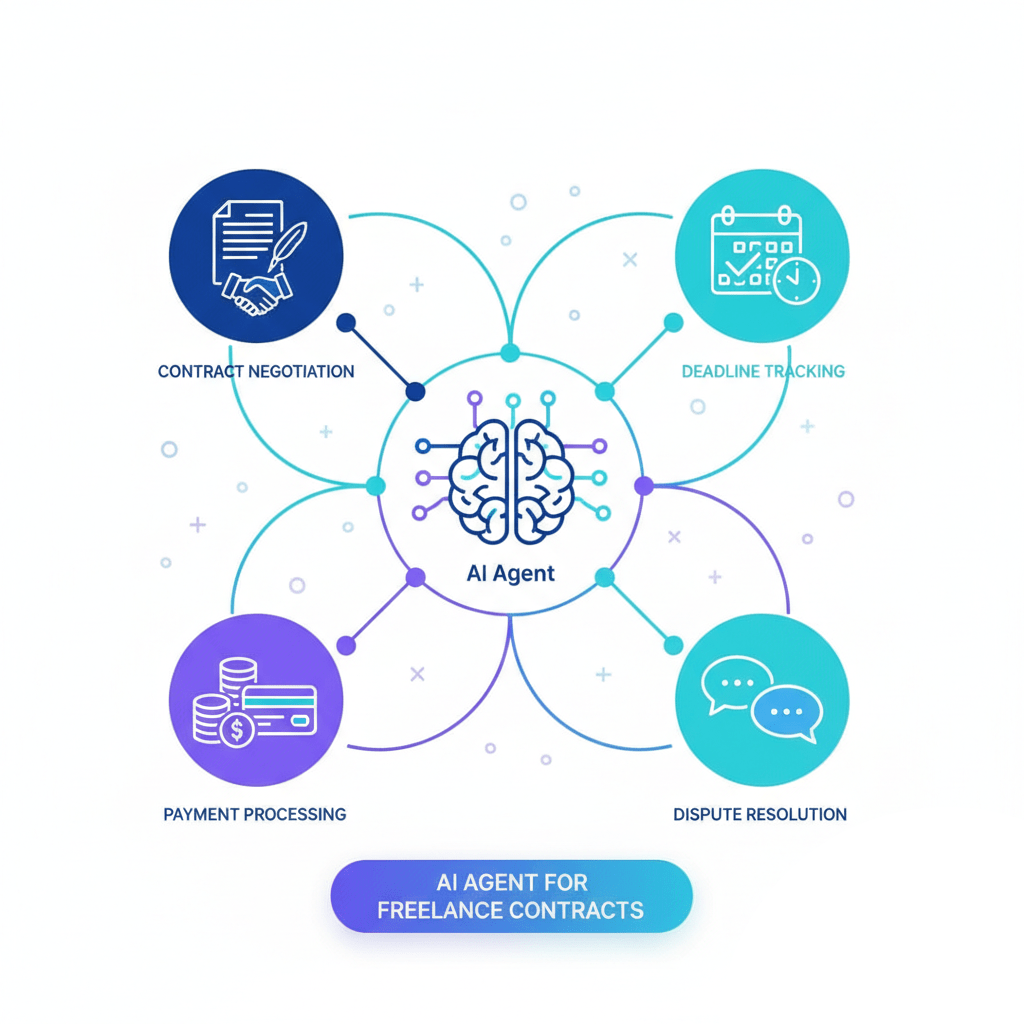
This is the power of an AI Agent for managing freelance contracts and policies. It’s about transforming your stack of static documents into an interactive, 24/7 resource that empowers freelancers to self-serve. This article will break down the precise anatomy of this onboarding bottleneck and show you how a dedicated AI agent solves it for good.
The Anatomy of the Freelancer Onboarding Bottleneck
We know it’s a problem, but to fix it, we have to appreciate just how deep the problem runs. The friction in freelancer onboarding isn’t one single issue; it’s a three-headed beast that frustrates freelancers, burns out managers, and exposes the company to serious risks.
1. The Manager’s “Groundhog Day” (The Time & Productivity Sink)
Meet Sarah. She’s an operations manager at a fast-growing tech company. Her teams rely heavily on external contractors for design, development, and marketing. Sarah’s primary job is to ensure projects run smoothly.
In reality, Sarah spends about 30% of her week acting as a human search engine.
- Monday 9:15 AM: A new UI/UX designer starts. They email Sarah asking for the company’s brand guidelines. Sarah digs through the marketing team’s shared drive and emails the 50MB PDF.
- Monday 11:30 AM: A freelance developer emails. The invoice they submitted last week was rejected. Why? They used the wrong PO number. Sarah needs to obtain the correct PO number from the finance lead and relay the information. The developer must now wait until the next payment cycle.
- Monday 3:00 PM: The UI/UX designer emails again. “The handbook says to submit invoices to ‘your project manager,’ but the contract says ‘the accounts payable portal.’ Which is it?” Sarah has to explain that the handbook is slightly outdated and provide the portal link.
- Tuesday 10:00 AM: A new content writer in a different time zone emails overnight. “My NDA mentions a ‘Confidentiality Period’ but doesn’t define the length. Can you clarify?” Sarah now has to contact the legal department, which then takes a day to respond and provides a boilerplate answer.
Sarah is smart, capable, and expensive. And your company is paying her to answer the same 10-15 questions repeatedly. This is a profound waste of human capital. Every minute she spends on this administrative churn is a minute not spent on resource planning, budget management, or removing actual project roadblocks.
This manual process doesn’t scale. If Sarah’s company hires five freelancers a month, it’s a problem. When they try to scale to 50 for a major launch, the entire system collapses.
2. The Freelancer’s “Black Box” (The Experience Problem)
Now let’s look at it from the other side. Meet David, a top-tier freelance consultant. He’s excited to work with Sarah’s company. He signs the contract, eager to dive in and show them what he can do.
Then, he gets the “document dump.”
He’s a professional, so he opens the 40-page MSA. He has a simple, practical question about the ‘Intellectual Property’ clause—specifically, does it prevent him from using non-confidential, general techniques he develops on this project for other clients? This is a standard question for a consultant.
He has two choices:
- Bother Sarah: He knows she’s busy. He doesn’t want to be “that guy” who asks a million questions before he’s even started. It makes him look high-maintenance.
- He can skim the document, not find a clear answer, and just hope for the best. This creates uncertainty and a feeling of professional unease.
He decides to email Sarah. He waits six hours for a response, which then has to be forwarded to the legal department. A simple question takes 24 hours to answer. In that time, David’s initial excitement had faded. His first impression of the company is one of disorganization. He’s wondering if they’ll be this slow to give feedback, approve milestones, or pay invoices.
Top talent has a choice. They will always gravitate toward clients who are easy to work with. A clunky, slow, and confusing onboarding process is a giant, flashing red sign that says, “We don’t have our act together.” This experience not only delays the project but also damages your employer’s brand and makes it harder to retain top talent and the best gig economy tools.
3. The Company’s “Ticking Time Bomb” (The Consistency & Compliance Risk)
This is the part that should keep your CFO and General Counsel up at night. When you rely on busy managers like Sarah to manually answer questions, you introduce a massive variable: human error.
- Inconsistent Answers: Sarah, swamped with work, tells a freelancer, “Oh, don’t worry about the portal, just email me your invoice.” Meanwhile, another manager, Mark, instructs his freelancer to use the portal exclusively. Accounts Payable is now receiving invoices from two different, unapproved channels. This creates chaos, risks duplicate payments, and makes financial audits a nightmare.
- Compliance & Misclassification: This is the big one. The line between an “independent contractor” (1099) and an “employee” (W-2) is one of the most litigated areas in labor law. When a freelancer asks, “What hours am I supposed to work?” or “Do I have to attend the weekly team stand-up?” a manager’s casual answer can have substantial legal consequences.
- Bad Answer (from a busy PM): “Yeah, just be online from 9 to 5 like the rest of the team, and I’ll see you at the 9 AM stand-up tomorrow.”
- What this implies: You are directing the manner and means of their work. This is a key test for an employer-employee relationship.
This casual “helping” by managers can be used as evidence of misclassification, which can lead to enormous fines, back taxes, and penalties.
Your static PDFs and manuals were vetted by legal. They contain the correct, compliant language. The problem is that no one reads them, and managers are forced to improvise. You are one “helpful” manager’s email away from a major compliance breach.
This trifecta of problems—wasted manager time, poor freelancer experience, and high compliance risk—is the direct result of a system that has not evolved to meet the demands of modern, project-based work.
The “Repetitive Question” Hall of Shame
Let’s get specific. What are these soul-crushing, time-wasting questions? If you work in operations or HR, you’ll probably feel a slight pang of recognition. These are the “greatest hits” that clog your inbox and delay your projects.
The root of the problem is that a freelancer’s questions are specific, but your documents are general. They don’t want to read a 40-page manual; they want a 40-word answer.
Here are the most common culprits, categorized by type.
Category 1: Contracts, NDAs, and the “Legal Stuff”
These are often the first and most intimidating hurdles. Freelancers want to sign, but they also want to protect themselves.
- “What does [Clause X.Y] mean in plain English?”
- The variants: “Can you explain the ‘Indemnity’ section?” “What’s covered under ‘Confidential Information’?” “What are the ‘Termination for Convenience’ terms?”
- Why it’s a problem: The manager is not a lawyer. They either give a non-answer (“You should ask your legal counsel”), which isn’t helpful, or they try to interpret it themselves, which is legally dangerous.
- “Can I redline or change this part of the contract/NDA?”
- Why it’s a problem: This kicks off a lengthy email chain. The request goes from the manager to legal, legal reviews it, emails the manager, and the manager emails the freelancer. This game of telephone can take a week, all before a single line of code is written.
- “How long does the NDA last?”
- The variants: “When can I add this project to my public portfolio?” “Does the NDA cover information I already knew?”
- Why it’s a problem: This is a simple, factual question. The answer is in the document. But it’s buried. The freelancer’s inability to find it instantly creates friction.
Category 2: Money, Money, Money (Payment & Invoicing)
These are, without a doubt, the most frequent and emotional questions. When a person’s livelihood is involved, uncertainty breeds anxiety.
- “What is the exact invoice submission process?”
- The variants: “Who do I send the invoice to?” “Do I email it, or is there a portal?” “Can I have the link to the portal?” “My portal login isn’t working.”
- Why it’s a problem: This should be the single most straightforward process in your company. When it’s not, it signals to the freelancer that getting paid will be a fight.
- “What information must be on the invoice?”
- The variants: “Do I need a PO number?” “Where do I find my PO number?” “Do I need to itemize my hours?” “What’s the ‘Vendor ID’ you’re asking for?”
- Why it’s a problem: An invoice without the correct PO number or vendor ID is an invoice that gets rejected by your accounting software. This means the freelancer’s payment is delayed, they get frustrated, and your finance team has to do manual reconciliation.
- “When will I get paid?”
- The variants: “What does ‘Net 30’ mean? 30 days from when I send it, or 30 days from when you approve it?” “What’s the cutoff date for this month’s payment run?”
- Why it’s a problem: Ambiguity surrounding payment terms is a primary source of conflict between freelancers and clients. A clear, consistent, and easily accessible answer is non-negotiable.
Category 3: Compliance & Classification (The “1099 Questions”)
These are the innocent-sounding questions that hide the most risk. They are attempts by the freelancer to understand the boundaries of the work relationship.
- “What hours am I expected to work?”
- The variants: “Do I need to be online from 9-to-5?” “Is it okay if I work on this over the weekend?”
- Why it’s a problem: This is a classic “independent contractor compliance” trap. The correct answer is, “As an independent contractor, you control your own hours. We are engaging you for the deliverable, not your time. Our core hours for meetings are X, but your work hours are up to you.” A manager just says, “Yeah, we all work 9-5.” Boom. Compliance risk.
- “Do I have to attend the [Daily Stand-up/Weekly Team Meeting]?”
- Why it’s a problem: Similar to the hours question, requiring attendance at internal team meetings that aren’t directly related to the project deliverables can be seen as “behavioral control,” a key factor in a misclassification audit.
Category 4: Tools, Access, and “How-To”
These are the simple logistical questions that become major roadblocks.
- “How do I get access to [Slack/Jira/Google Drive/Github]?”
- The variants: “Who is the admin for the shared drive?” “My invite expired. Can you resend it?”
- Why it’s a problem: The project can’t start until the freelancer has access to the tools. This often involves a different department (like IT), creating another link in the chain of dependencies.
- “Who is my main point of contact?”
- The variants: “Who do I go to for project feedback?” “Who do I contact for a payment issue?” “Who is my SOW/Contract manager?”
- Why it’s a problem: Your company’s internal org chart is invisible to a freelancer. They see one company. When their project manager can’t answer an invoice question, and the finance person can’t answer a scope question, the freelancer is stuck in a loop.
Every single one of these questions represents a failure of process. They are all answerable. The answers exist. They are often locked away in documents that are difficult to search and workflows that are designed for full-time employees, rather than a flexible, project-based workforce.
The Solution: The AI Agent for Managing Freelance Contracts
So, the process is broken. Your managers are burnt out, your freelancers are frustrated, and your lawyers are nervous. How do you fix it?
You don’t need a bigger manual. You don’t need more HR staff.
You need to change the interface. You need to move from a “push” system (emailing static PDFs) to a “pull” system (letting freelancers get instant answers).
This is the job of an AI Freelancer Onboarding Assistant.
This isn’t a simple, dumb chatbot that only knows three pre-programmed answers. This is an AI agent, powered by a large language model, that has read and understood your entire library of freelancer documentation. It acts as a 24/7, infinitely patient, and perfectly compliant expert on your company’s processes.
How It Works (and Solves Everything)
Let’s see how this AI agent tackles the “Hall of Shame” questions we just covered.
1. You Feed It the “Brain” First, you provide the AI with its knowledge base. You give it all the “Single Source of Truth” documents:
- Your standard Master Services Agreement (MSA) template.
- Your Non-Disclosure Agreement (NDA).
- Your 50-page “Freelancer & Vendor Handbook.”
- The step-by-step “Invoice Submission Process” guide from Finance.
- Your company’s Brand & Style Guidelines.
- Any SOW templates or standard project policies.
2. The AI Reads and Understands. The AI agent ingests these documents. It doesn’t just store them. It reads them for context. It understands that “Section 7.a” of the MSA relates to “Section 4.b” of the SOW. It learns the relationships between different pieces of information.
3. The Freelancer Asks a Question A new contractor, David, logs into his welcome portal. He sees the chat agent.
- David types: “What does the ‘Indemnity’ clause in my contract mean?”
- AI Agent Responds: “The Indemnity clause (Section 8.1 of your MSA) means that you agree to cover any legal costs or damages the company might face if your work (e.g., your code or design) infringes on a third party’s copyright. It’s a standard clause to protect the company from legal claims related to your deliverables. Would you like me to summarize Section 8.1 for you?”
4. The Bottleneck is Gon. Notice what just happened.
- The answer was No, 24-hour wait.
- The answer was accurate. It cited the exact clause.
- The answer was safe. It explained the concept in plain English without giving “legal advice.”
- Sarah, the manager, was never involved. She’s busy managing the project.
Let’s run through a few more.
- Freelancer asks: “I need to send my invoice. What’s the process?”
- AI Agent Responds: “Great! According to our ‘Vendor Invoicing Guide,’ all invoices must be submitted as a PDF through our vendor portal here: [link]. Your invoice must include your unique Vendor ID (which is [V-12345]) and the correct PO number for your project, which is [PO-98765]. Invoices submitted by the 5th of the month are paid on the 30th (Net 25).”
- Freelancer asks: “Do I have to attend the 9 AM daily stand-up?”
- AI Agent Responds: “As an independent contractor, your attendance at internal team meetings like daily stand-ups is not required. Your SOW outlines two (2) required check-in meetings per month for milestone review. However, your project manager may invite you to optional project discussions if you’d like to join. Your work hours and methods are your own.”
This is a game-changer. Let’s examine the specific, high-impact benefits this new model offers.
Benefit 1: Radical Speed and 24/7 Availability
Time is money—a three-day delay in onboarding results in a three-day delay in the project’s start. An AI agent eliminates this delay. It works 24/7, across all time zones. The freelancer in London can get a contract question answered at 10 PM their time without having to wait for the manager in New York to wake up. This means freelancers are vetted, onboarded, and productive in hours, not days or weeks.
Benefit 2: Perfect Consistency and Ironclad Compliance
This is the most powerful benefit for the company. The AI agent is your ultimate compliance officer.
- It provides the same, correct, and legally vetted answer every single time.
- It never gets tired, creative, or “casually helpful.”
- When a freelancer asks a potentially hazardous “1099 employee question,” the AI provides a perfectly compliant, pre-approved answer that reinforces their status as an independent contractor.
- When your invoicing process changes, you don’t need to retrain 50 project managers. You update one document, feed it to the AI, and the AI agent instantly uses the new information. This resolves the “outdated handbook” issue once and for all.
Benefit 3: Frees Your Managers to Actually Manage
By automating the low-level, repetitive Q&A, you give your most valuable resource—your managers’ time and attention—back to them.
Sarah, our stressed-out operations manager, is now free to focus on high-value tasks:
- Strategic planning for the project’s next phase.
- Reviewing the quality of the freelancer’s deliverables.
- Managing the project budget and timeline.
- Building a relationship with the freelancer, rather than just being a support desk.
This dramatically improves her job satisfaction, reduces burnout, and makes her (and her projects) more effective. This is the true promise of HR automation: not replacing humans, but unblocking them.
Benefit 4: Creates a Modern, Professional Onboarding Experience
First impressions matter. Which company would you rather work for?
- Company A: Sends you a zip file of 8 different, conflicting PDFs and tells you to “email Sarah with any questions.”
- Company B: Sends you a single link to a clean, professional portal with an intelligent assistant that says, “Welcome! I’m here to help you get started. Ask me anything about your contract, payment, or project.”
The choice is obvious. Top talent is a scarce resource. By providing a seamless, modern, and respectful onboarding experience, you differentiate yourself as an employer of choice. It shows that you value the freelancer’s time and signals that your company is organized, efficient, and professional. This is a massive competitive advantage in the war for talent.
You Don’t Need a Data Science Team: Building Your AI Agent
At this point, you might be thinking, “This sounds great. But it also sounds expensive. We don’t have a team of AI engineers or a million-dollar budget.”
Five years ago, you’d be right. This technology would have required a massive, custom development project.
Today, that is no longer true.
The rise of no-code AI platforms has completely changed the game. You no longer need to build complex AI models; you just need to train them on your specific information. This has put the power of tools previously only available to Google or Microsoft into the hands of any HR professional, operations manager, or project manager.
Building your AI Freelancer Assistant is now a simple, straightforward process that anyone can do, without writing a single line of code.
Here is the general workflow:
- Gather Your Knowledge: You start by creating a “brain” for your AI. This is as simple as collecting all your freelancer-facing documents into a single folder. This is the “Single Source of Truth” we’ve been talking about.
- Freelancer_Handbook.pdf
- MSA_Template.docx
- NDA_Standard.pdf
- Invoicing_Process_Guide.pdf
- Brand_Guidelines.pdf
- Project_Tools_Access_FAQ.txt
- Upload to a No-Code Platform: You log into a no-code AI agent builder. You create a new “agent” (let’s call it “Freelancer Onboarding Pal”) and simply drag and drop your files into the uploader.
- Click “Train”: You press a button. The platform’s AI engine reads all your documents, indexes the content, and understands the context and relationships between them. This process, which used to take months, now often takes a few minutes.
- Test and Refine: You immediately get a chat window to “talk” to your new AI agent. You can start testing it by asking it the “Hall of Shame” questions:
- “When will I get paid?”
- “Who do I send my W-9 to?”
- “What are the rules about portfolio use?”
- You’ll see it instantly provide answers, and many platforms will even show you the source it used (e.g., “Answer found in Invoicing_Process_Guide.pdf, page 2, paragraph 3”). This gives you 100% confidence in the accuracy.
- Deploy Everywhere: Once you’re satisfied, the platform provides a simple way to share your agent. This could be a single line of code to embed on your company’s vendor portal, a direct hyperlink you can include in your welcome emails, or an integration with a tool like Slack.
That’s it. The entire process can be completed in an afternoon.
The Easiest Way to Start: Introducing Scalewise.ai
We’ve spent the entire article detailing the problem, outlining the ideal solution, and demonstrating how achievable it is. Now, let’s give you the tool that makes it a one-click reality.
The ideal platform for building this AI Freelancer Onboarding Assistant is Scalewise.ai.
Scalewise.ai was designed for this exact use case. It is a free, no-code AI Agent Builder that empowers companies to transform their mountains of static freelancer manuals, contracts, and policies into a single, interactive, and intelligent resource.
Here is why Scalewise.ai is the right choice:
- It’s No-Code, Built for You: You don’t need to be a technical expert. If you can create a folder and drag-and-drop files, you have all the necessary skills. The platform is built for HR leads, operations managers, and PMs—the very people who are feeling this pain.
- It’s Instant: You can go from a folder of messy PDFs to a fully functioning, testable AI agent in under 5 minutes.
- It’s Accurate: Scalewise.ai is designed for “Question and Answer” over your own documents. Its “Retrieval-Augmented Generation” (RAG) technology means it doesn’t just “guess” the answer; it finds the answer in your documentation and provides it. This is crucial for contract and policy questions, where accuracy is paramount.
- It’s Free to Start: You can build and test your agent right now, for free. This isn’t a long, drawn-out sales demo; it’s an immediate solution. You can prove the value to your team before you ever spend a dime.
With Scalewise.ai, you can finally break free from email chains. You can stop the repetitive questions. You can prevent the project delays. You can build a smooth, fast, and consistent onboarding experience for every single contractor, every single time.
This is how you win in the project-based economy. You don’t just hire the best talent; you give them the best experience.
Conclusion: Stop Answering, Start Automating
The shift to a contingent workforce is here to stay. The agility it provides is a critical competitive advantage. However, this advantage is being slowly eroded by an outdated, manual onboarding process that exhausts your managers and frustrates your talent.
Relying on “just sending the PDF” and using your high-skill managers as human FAQ pages is no longer a viable strategy. It’s slow, risky, and doesn’t scale.
The solution is clear. You must automate the non-human parts of the process. The repetitive, factual, and logistical Q&A that forms the bulk of the onboarding bottleneck can and should be handled by an AI agent.
By creating an AI Agent for managing freelance contracts and policies, you build a scalable system that delivers:
- Speed: Instant answers, 24/7.
- Compliance: Perfect, consistent answers, every time.
- Efficiency: Your managers are free to focus on their core responsibilities.
- Experience: Your freelancers are empowered, not frustrated.
This isn’t a far-future-of-work idea. With a no-code tool like Scalewise.ai, you can build this exact solution today, for free. You can transform your static, ignored manuals into the single most helpful onboarding tool you have.
Stop being a search engine. Start being a manager. Stop being a bottleneck. Start building.
Frequently Asked Questions (FAQs)
Q1: What exactly is an “AI Agent for managing freelance contracts”?
An AI Agent is an intelligent chat assistant that you’ve trained on your specific company documents. Instead of freelancers having to read a 30-page PDF to find one answer, they can simply ask the agent a question in plain English (e.g., “When are my invoices due?”), The agent will provide them with an instant, accurate answer based on the information in your documents.
Q2: Is this secure? Our contracts and policies are confidential.
This is a critical question. Reputable platforms like Scalewise.ai are built with security in mind. Your documents are not used to train public AI models (like the public-facing ChatGPT). They are stored securely, and the AI agent you build is private to your organization. You control who has access to it. Always check the platform’s security and data privacy policies.
Q3: Won’t this feel impersonal to new freelancers? We value the “human touch.”
This is a common concern, but it stems from a misunderstanding of the goal. The AI agent removes impersonal, low-value friction, making more room for the human touch.
Think about it:
- Impersonal: Forcing a freelancer to email you for a portal link and wait 6 hours for a reply.
- Personal: The AI gives them the link instantly, so on your first “human” call, you can skip the logistics and instead ask, “What are your big ideas for this project? How can I best support your success?”
The AI handles transactions, allowing your managers to focus on building relationships.
Q4: What if the AI gives the wrong answer? That seems dangerous.
This is the key difference between a generic public AI and a purpose-built agent. A good platform is designed to prevent making things up. It uses a technology called Retrieval-Augmented Generation (RAG), which means it will only answer based on the information it finds in your documents. If it can’t find an answer, it’s programmed to say, “I cannot find the answer in the provided documents. Please contact your project manager.” Furthermore, platforms like Scalewise.ai can often cite their sources (“I found this on page 4 of the Vendor Handbook”), allowing you to verify their accuracy.
Q5: How long does it really take to build this with Scalewise.ai?
It truly is fast. The technical part—uploading your documents and training the agent—takes less than 10 minutes. The human part that might take an hour or two is simply gathering your documents. You merely need to locate your latest handbook, the standard MSA, and the invoicing guide. Once you have those files, you are minutes away from a working prototype.
Q6: My company’s documents are a total mess. Some are old, some conflict. Does that matter?
This is actually a feature, not a bug. The process of building your AI agent forces you to clean up your messy processes. When you test your agent, you may find that it gives two different answers to “What’s the payment term?” because one document states “Net 30” and another states “Net 45.” This is a huge, flashing sign that your process is broken! The AI acts as a mirror, highlighting where your inconsistencies lie. You can then fix the source documents, re-upload them, and instantly create a “Single Source of Truth” for your entire freelance workforce. It’s the fastest way to drive process improvement.