


“Deploy powerful AI for Direct Booking Websites to stop paying OTAs, eliminate visitor doubt with instant answers, and convert more lookers into profitable, commission-free reservations.”
You know the feeling. You review your monthly financials, and there it is, staring you in the face: the line item for OTA commissions. It’s a significant, painful number. It’s the cost of doing business, you might tell yourself. But what if it’s not? What if it’s the cost of a missed opportunity?
For years, Online Travel Agencies (OTAs) like Booking.com and Expedia, along with their subsidiaries, have positioned themselves as indispensable partners. They offer a “billboard effect,” promising visibility to millions of travelers. In exchange, they demand a steep price—commissions that range anywhere from 15% to as high as 30% of your room revenue. This isn’t just a fee; it’s a direct drain on your profitability.
Think about that. For every $100,000 in revenue they generate, you immediately hand back $20,000. That’s money that could have gone into property upgrades, staff bonuses, or your own marketing efforts. This dependency has created a hospitality landscape where hoteliers feel trapped, forced to pay tolls on a road they helped build.
The most frustrating part? Many of those guests visited your website.
They saw your listing on the OTA, and just before booking, they opened a new tab. They searched for your hotel directly. They landed on your beautiful, custom-built website. They browsed your photo gallery. They looked at your room types. And then… they left.
They returned to the OTA and completed their reservation, locking in that 20% commission for the middleman.
Why? What causes this digital exodus?
The answer is surprisingly simple: Your website didn’t answer their questions.
At the exact moment of decision, a slight, specific doubt entered their mind—a moment of friction.
“The ‘Deluxe Room’ looks nice, but does it have a bathtub or just a shower?”
“I’m traveling with my kids. Do you have connecting rooms?”
“We’re driving in. How much is parking, and is it guaranteed?”
“What is your actual pet fee? The policy page is confusing.”
“I need to check in late, around 1 AM. Is the front desk open 24/7?”
When faced with these specific, practical questions, your static website offered no immediate reply. Your FAQ page was a wall of text they didn’t want to read. Your “Contact Us” form promised a reply in 24 hours, but they wanted to book now.
So, they did the easy thing. They clicked back to the OTA, where the booking process is standardized, and a massive, impersonal system often smoothes over their questions (or fears). You lost the booking. You lost the customer data. And you lost the profit.
This cycle is breaking hotel profit margins. But there is a powerful new way to stop it.
Imagine a new team member. This employee is your single best expert in reservations. They are available 24/7, 365 days a year. They speak multiple languages. They never get tired, never have a bad day, and never forget a single detail about your property. Most importantly, they can have a one-on-one, real-time conversation with every single visitor who lands on your website, at the exact moment they have a question.
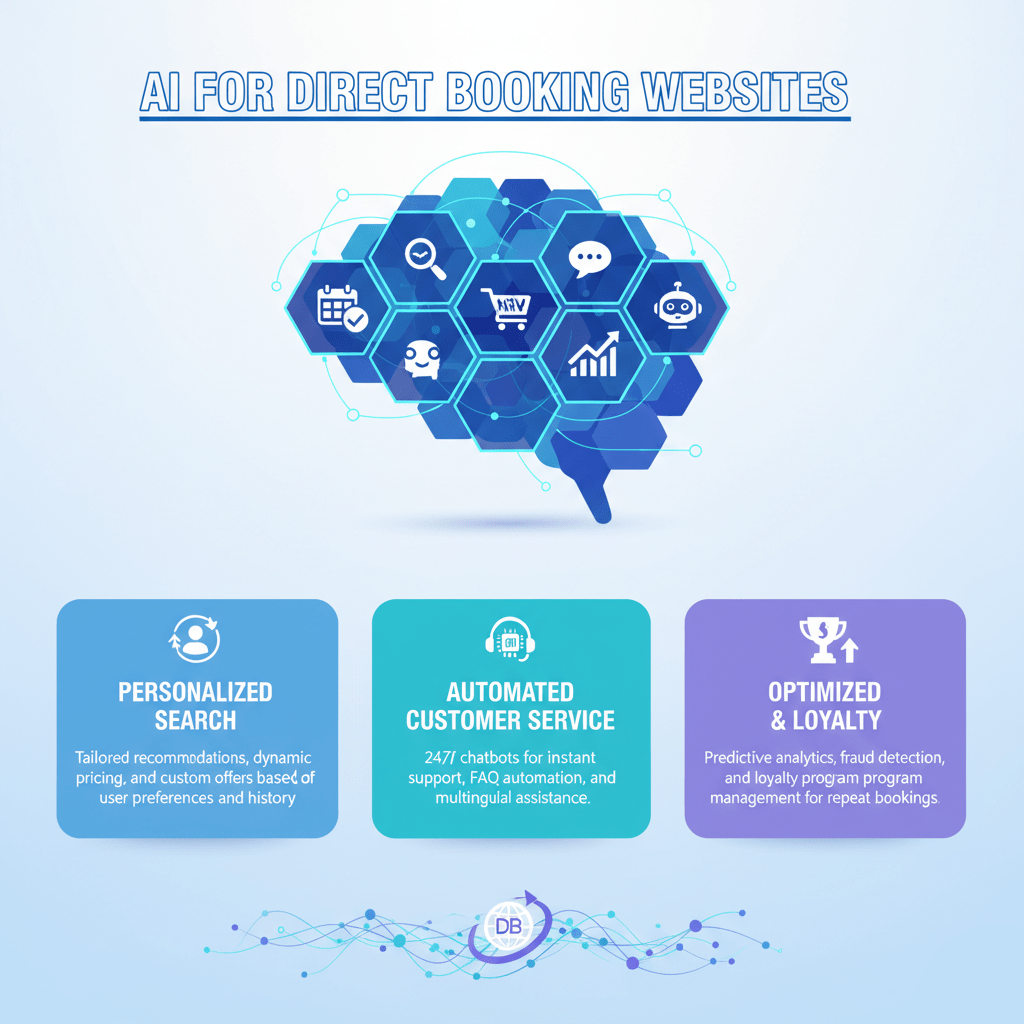
This isn’t a future fantasy. This is the new reality of AI for direct booking websites. A conversational AI agent acts as that expert, turning your passive website into an active, persuasive booking assistant that guides hesitant visitors straight through the booking funnel and secures that commission-free reservation.
The Crushing Weight of OTA Commission Costs
Let’s get specific about the problem. The “OTA problem” isn’t just a minor annoyance; it’s a strategic threat to your hotel’s long-term financial health. When we discuss OTA commission costs, we are referring to a cascade of adverse effects that extend far beyond the initial percentage.
The Math That Hurts
Consider a hypothetical 100-room independent hotel.
Average Daily Rate (ADR): $180
Average Occupancy: 75%
Annual Room Revenue: (100 rooms * $180/room * 0.75 occupancy * 365 days) = $4,927,500
Now, let’s say 40% of your bookings come from OTAs, a prevalent scenario.
OTA-Generated Revenue: $4,927,500 * 0.40 = $1,971,000
Let’s apply an average 20% commission.
Annual Commission Paid to OTAs: $1,971,000 * 0.20 = $394,200
That is nearly $400,000. It’s a massive payroll. It’s a complete renovation of your lobby. It’s a new pool deck. It’s your entire year’s marketing budget. Instead, it’s walking out the door, straight into the pockets of a tech giant.
But the damage doesn’t stop there.
The Rate Parity Handcuffs
To add insult to injury, most OTA contracts include “rate parity” clauses. These clauses legally forbid you from offering a lower price on your own website than you do on the OTA.
Think about the absurdity. You are contractually obligated to make your most expensive, commission-heavy channel (the OTA) appear to be the same price as your most profitable, commission-free channel (your website).
This creates massive confusion for travelers. They see the same price on Expedia and on YourHotel.com. With no clear price advantage, they default to what they know. They book with the OTA, assuming it’s the “official” or “safest” bet. The game feels rigged because it is—against you.
You cannot win on price, so you must win on value and service.
The Black Hole of Customer Data
This might be the most damaging, long-term effect. When a guest books through an OTA, who “owns” that guest? The OTA does.
You typically get a name and a temporary, masked email address (e.g., [email protected]). You have no way to add this guest to your pre-arrival email sequence. You can’t add them to your loyalty program. You can’t send them a “Welcome Back” offer for their anniversary.
You cannot build a relationship.
That guest is now an OTA customer who happened to stay at your property. You are completely disintermediated from your own clientele. You’re forced to “re-buy” that same guest with another 20% commission the next time they travel.
Direct bookings, on the other hand, are a goldmine. You receive the guest’s real email address, phone number, booking preferences, and their full consent to market to them. A direct booking isn’t just one reservation; it’s the potential for a lifetime of reservations. It feeds your hospitality CRM (Customer Relationship Management) system and becomes the engine for all your future hotel marketing strategies.
Losing this battle isn’t just about losing a percentage of one booking; it’s about losing the opportunity to make a lasting impression. It’s about losing the entire future value of that guest.
The Moment of Doubt: Why Visitors Really Abandon Your Website
So, we’ve established the “why.” You need direct bookings to survive and thrive. You’ve spent thousands of dollars on a stunning website with a professional booking engine. A guest lands on it. They are interested. They have their credit card on the desk.
And… they leave. This is the “leaky bucket” problem.
Your website analytics show the traffic. You see the high bounce rate. You see the abandoned booking engine sessions. Your look-to-book ratio—the percentage of visitors who actually complete a reservation—is tragically low.
The core reason, as we touched on, is friction. It’s the collection of small, unanswered questions that creates doubt. In the digital age, doubt is the enemy of conversion. Any moment of hesitation is an invitation to click away.
Let’s dissect these moments of doubt. They usually fall into a few key categories.
1. Room & Amenity Specifics
Your booking engine might say “Deluxe King,” but the user is thinking:
“Does ‘deluxe’ mean it has a balcony? The photos are generic.”
“I see ‘sofa bed.’ Is that a tiny loveseat or a proper pull-out queen?”
“You say ‘ocean view,’ but am I going to get a tiny sliver of blue if I crane my neck?”
“I’m a light sleeper. Are these rooms facing the street or the courtyard?”
“Is the pool heated? We’re coming in November.”
“What exactly is the ‘complimentary continental breakfast’? Is it just muffins, or is there a hot option?”
These are not trivial questions. They are value calculations. The user is trying to determine if your $250/night room is worth $250. If they can’t get a clear, instant answer, they’ll book the $230/night (plus commission) room at your competitor via an OTA, because its “Standard King” description, while boring, felt safer.
2. Policy & Fee Anxiety
This is the biggest killer of conversions. Hidden fees and confusing policies have burned travelers. They are on high alert.
“What is your exact cancellation policy for the ‘Book Now, Pay Later’ rate? The fine print is confusing.”
“I’m bringing my 50lb golden retriever. Your pet policy says ‘pets allowed,’ but are there weight or breed restrictions? What is the pet fee per night?”
“I see a ‘Resort Fee’ mentioned. What does that include, and how much is it? I don’t want a $40/day surprise at check-in.”
“How much is parking? Is it an on-site garage or a third-party facility? Can I come and go (in-and-out privileges)?”
If your website makes them hunt for these answers, you have failed. They will not hunt. They will click back to Booking.com, which itemizes (most) of these fees in a standardized format, removing the anxiety.
3. Logistics and Location
The guest is trying to plan their entire trip, and your hotel is just one piece of the puzzle.
“My flight lands at midnight. Is your front desk staffed 24/7, or will I be locked out?”
“We are coming for a convention at the XYZ Center. You say you are ‘nearby,’ but can I walk there? Or is it a 10-minute drive?”
“How far are you from the nearest subway station/beach access / main street?”
“Do you offer an airport shuttle? If so, how often does it run?”
These are practical, yes/no questions that determine the feasibility of their entire trip. A lack of clarity here is a deal-breaker.
The traditional solution—a static FAQ page—is no longer good enough. It’s a relic of a bygone internet era. It forces the user to stop their booking journey, navigate to a new page, scan a massive list of 50 questions, and hope their specific query is listed.
This is friction. This is why you lose.
The Solution: A 24/7 Digital Reservations Expert on Your Payroll
This is where you flip the script. You can’t stop guests from having questions. However, you can adjust your response to them.
Imagine a visitor lands on your “Rooms” page. They’re scrolling, looking confused. After 10 seconds, a polite, professional chat window appears in the corner.
“Hi there! I see you’re looking at our Deluxe King rooms. I’m Alex, your digital booking assistant. Did you know that all our Deluxe King rooms feature private balconies and walk-in rain showers? I can also check availability for you.”
This is not a “chatbot.” A chatbot is a dumb, button-based menu (“Press 1 for Reservations, Press 2 for Dining”). An actual conversational AI agent is an expert. It’s trained on your hotel’s specific data. It can understand natural language and provide instant, accurate, and persuasive answers.
This is the key to website conversion optimization. It’s not about changing the color of your “Book Now” button. It’s about fundamentally changing the user experience from a passive brochure to an active, helpful conversation.
Here is how this AI agent single-handedly solves your direct booking problem.
1. It Instantly Answers Specific Booking Questions
Let’s replay those moments of doubt, but this time with an AI agent.
User: “Do you have connecting rooms for a family of 5?”
AI Agent: “Yes, we do! Our Deluxe Queen rooms can connect to our Deluxe King rooms. This combination is perfect for families, offering two full bathrooms. What dates are you traveling? I can check for that specific setup right now.”
User: “What’s your pet fee?”
AI Agent: “We love four-legged guests! There is a one-time, non-refundable pet fee of $75 per stay, for up to two dogs. We don’t have weight restrictions, but we do ask that they are never left unattended in the room. We even provide a complimentary dog bed and water bowl!”
User: “Is parking free?”
AI Agent: “We offer secured, on-site garage parking for $25 per night, which includes in-and-out privileges. However, when you book directly with us on this site, we are happy to offer you 50% off your parking fee.”
Notice the difference. The answer is instant. It’s detailed. And in the last example, it does something crucial: it pivots.
2. It Proactively Highlights “Book Direct Benefits”
Your AI agent’s primary role is to serve as your chief salesperson, continually reinforcing why a guest should book on your site instead of through an OTA. You can’t win on price (because of rate parity), so you must win on value.
The AI agent becomes the perfect delivery mechanism for your book’s direct benefits.
Visitor: “What’s the best rate for October 10th?”
AI Agent: “The best available rate for that night is $229. And I want to make sure you know that by booking here on our website, that rate also includes:
Complimentary Hot Breakfast for two ($40 value)
Complimentary High-Speed Wi-Fi
Guaranteed 2 PM Late Checkout ($30 value)
Flexible 24-Hour Cancellation
You won’t get these perks if you book through an OTA. Would you like me to secure that rate for you?”
Suddenly, the “same” $229 price is no longer the same. The AI has just framed the direct booking as a $70+ value-add. It has given the user a powerful, logical reason to abandon the OTA and book with you.
This is how you fight back against rate parity. You make your direct channel the obvious choice for any savvy traveler.
3. It Guides Hesitant Visitors Through the Funnel
The AI agent is more than just an encyclopedia. It’s a guide. It’s trained to understand conversational cues and nudge the user toward the “Book Now” button.
It moves them from “just looking” to “booked.”
It creates urgency: “I see you’re looking at our ‘Fall Getaway’ package. That’s a great choice, but it’s one of our most popular and only has four spots left for that weekend. I can hold a room for you for 10 minutes while you decide.”
It cross-sells and up-sells: “You asked about the Standard Room. For just $20 more, our Deluxe Room includes the walk-in shower you requested and a significantly better view. Would you like to see a comparison?”
It handles objections: “I understand $250 seems high. However, please keep in mind that the rate includes our full-service spa access and complimentary shuttle service anywhere within the downtown loop, which saves you on ride-sharing fees.”
This AI agent is your 24/7 conversion machine. It identifies the friction, smooths it out with information, and paves the way for a completed, commission-free booking.
Beyond the Booking: The Data Goldmine You’re Sitting On
This strategy does more than just increase direct bookings. It transforms your website from a simple brochure into your primary source of business intelligence.
Every question a visitor asks your AI agent is a piece of data. Every chat log is a direct, unfiltered insight into what your customers actually want. This is far more valuable than any survey or analytics report.
Capturing “Travel Intent Keywords”
Your marketing team spends a fortune trying to guess what “keywords” people use to find you. Your AI chat logs tell you exactly what they care about once they’re on your site.
You review the logs and see the same questions over and over:
“Do you have EV charging stations?”
“Are you near the cruise port?”
“Is your restaurant vegan-friendly?”
“How good is the Wi-Fi? I have to take video calls for work.”
This isn’t just a list of questions; it’s your new marketing plan.
“EV charging” is asked 50 times a month? You now have a clear business case to install two charging stations. The next day, you train your AI to say, “Yes, we have two Tesla charging stations available for guests.” You’ve just cornered a new, affluent market.
“Cruise port” is a constant query? You create a “Park & Cruise” special offer promotion. You train the AI to promote it: “Yes, we are only 10 minutes from the cruise port. We actually have a ‘Park & Cruise’ package that includes one night’s stay, 7 nights of parking, and a round-trip shuttle to the terminal.”
“Vegan-friendly” keeps coming up? You work with your F&B manager to add three dedicated vegan items to the menu and update the AI.
You are no longer guessing what your guests want. They are telling you, every single day. This allows you to stop reacting to the market and start leading it.
A Seamless Feed for Your Hospitality CRM
The AI agent doesn’t just close the loop on conversions; it opens the loop for future marketing.
What about the visitor who doesn’t book?
User: “I’m looking for rates for Christmas, but I’m not ready to book yet.”
AI Agent: “I understand! Christmas is a beautiful time here. Our holiday rates have not been finalized yet, but they will be announced within the next two weeks. Would you like to leave your email address? I can personally notify you the moment our holiday specials go live, so you get first access.”
User: “Yes, please. It’s [email protected].”
Boom. That’s a high-intent, qualified lead. That email is automatically sent to your hospitality CRM (like Mailchimp, HubSpot, or a specialized hotel CRM) and tagged with “Interest: Christmas.”
This visitor, who would have been an anonymous bounce in your analytics, is now a warm lead. You’ve captured their travel intent and earned permission to market to them. You’ve started building the relationship before they ever spend a dollar.
When you multiply this interaction by hundreds of visitors a week, you begin to see how an AI agent becomes the single most powerful tool for building your direct-booking database and breaking your reliance on the OTAs for good.
Your New Most Valuable Employee Is Free
At this point, the strategic advantage is clear. You stop the bleeding of OTA commissions. You finally fix your website’s “leaky bucket.” You convert hesitant visitors by answering their questions instantly. You gather invaluable market intelligence. You build your CRM and your direct marketing list.
The only remaining question is “How?”
In the past, this level of technology was reserved for global mega-chains with multi-million dollar IT budgets. It was complex, expensive, and required a team of developers to manage.
This is no longer the case. The technology has evolved.
We built Scalewise.ai for this exact purpose. Every hotel, from a 20-room boutique to a 500-room resort, should have the power to fight back against the OTAs and own its customer relationships.
Scalewise.ai is a free and powerful AI Agent Builder. We designed it specifically for hotel owners and marketing managers, not for coders. You can build a sophisticated, persuasive, 24/7 AI booking assistant in minutes, without writing a single line of code.
Here’s how simple it is:
You give it knowledge: You don’t “train” it in a complex way. You simply give it your information. You can upload your policies, room descriptions, a PDF of amenities, or even just provide your website URL. It reads and understands it all.
You set its goals: You tell it, “Your primary goal is to increase direct bookings. Your secondary goal is to promote our ‘Book Direct’ benefits.”
You deploy it: You copy a single line of code and paste it onto your website. That’s it. It’s live.
Your new AI agent is now on the job, greeting every visitor, answering their specific questions about pet fees and connecting rooms, and persuasively highlighting your complimentary breakfast and late checkout. It’s overcoming objections, capturing leads for your CRM, and converting your hard-earned website traffic into profitable, commission-free reservations.
This is the turning point. This is how you take back control. The OTAs have relied on their massive technology budgets to outmaneuver you for years. Now, you can deploy the same powerful AI technology on your own turf.
Stop paying a 20% commission for a guest you should have won yourself. Stop letting visitors abandon your website because of a simple, unanswered question.
It’s time to turn your website into your single best salesperson.
Start building your free AI booking agent with Scalewise.ai today and take back your revenue.
Frequently Asked Questions (FAQs)
Q1: Will an AI agent like this annoy my website visitors?
This is a valid concern, as we’ve all been frustrated by “dumb” pop-up bots. The difference is in the intelligence and intent. A high-quality AI agent is not an annoying pop-up. It’s a “reactive helper.” It can be configured to appear only when a user shows confusion (such as scrolling on a page for a long time) or to sit passively as a “Help” icon until clicked. Because it provides immediate, accurate value (such as answering a complex policy question in two seconds), users don’t perceive it as an annoyance. They see it as excellent customer service.
Q2: Is setting this up complicated? I’m a hotel manager, not a coder.
This is the most common misconception. Tools like Scalewise.ai were explicitly built for non-technical users. The process is designed to be incredibly simple. If you can write an email or upload a document (such as your hotel’s fact sheet), you possess all the necessary technical skills. You “train” the AI by providing it with your existing documents. It “learns” your property instantly. Adding it to your site is as simple as copying and pasting one line of text into your website’s header—a 5-minute job your website admin can do.
Q3: How is this different from the basic chatbot my website platform already offers?
The difference is night and day. A “chatbot” is typically a rigid, button-based menu. It forces the user down a pre-set path (“Press 1 for X, Press 2 for Y”). If the user’s question is “What’s the pet fee?”, they have to guess which button to press.
A “conversational AI agent” understands natural language. The user can type “I’m bringing my poodle, is that cool, and What’s the fee?” The AI will understand the intent behind the slang and provide a specific, detailed answer. It’s the difference between a vending machine and a concierge.
Q4: My hotel is a small, 30-room boutique. Is this AI solution only for big chains?
Absolutely not. In fact, smaller, independent hotels have the most to gain. Large chains have 24/7 call centers. As a smaller property, you probably don’t. Your front desk staff is busy checking in guests. They can’t answer 10 simultaneous web chats at 10 PM. The AI agent levels the playing field. It gives your boutique hotel the same 24/7/365 customer service power as a Marriott or Hilton, allowing you to capture those late-night bookings you would have otherwise lost to an OTA.
Q5: What’s the real ROI on using AI for direct bookings?
The Return on Investment (ROI) is massive and multi-faceted.
Immediate ROI: You measure the number of direct bookings your AI agent influenced. If the agent helps secure just two $300 reservations that would have gone to an OTA, you’ve saved $120 in commissions (at 20%). The tool often pays for itself (especially if it’s free, like Scalewise.ai) on the very first day.
Long-Term ROI: This is the real prize. Every direct booking captured adds a guest to your CRM. The lifetime value (LTV) of that guest—who you can now market to for free, forever—is worth thousands.
Efficiency ROI: Your front desk and reservations staff spend less time in-person or on the phone answering the same 20 repetitive questions (“What time is check-out?”). The AI handles those, freeing up your team to provide better in-person guest experiences.